樓上城 The City Upstairs
Your childhood, still under construction
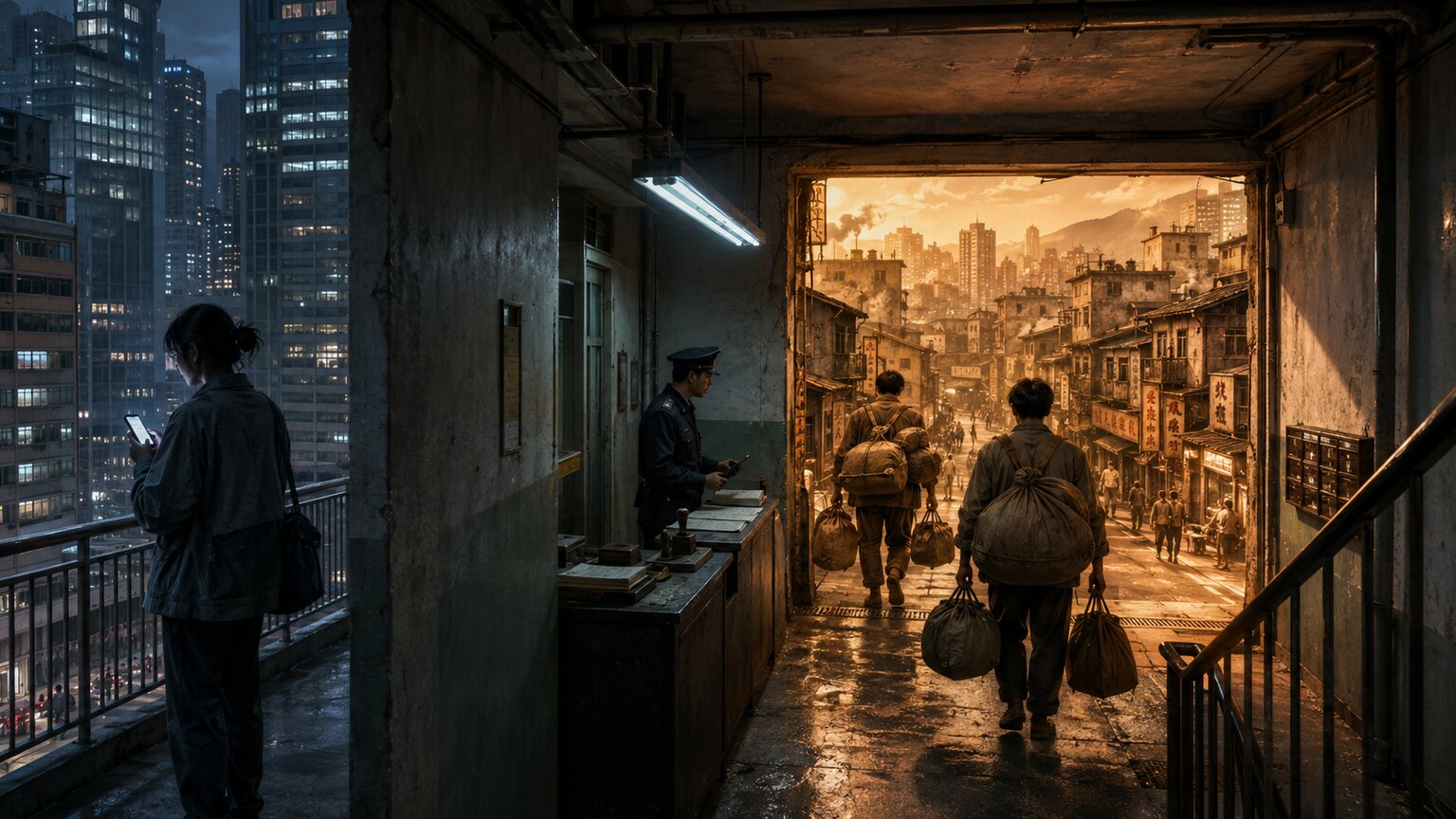
In Shimen, the top floor of every fifth apartment building opens onto the same city twenty years ago — which in Shimen means the boom: cranes to the horizon, mosaic tile and mirror glass, karaoke until four, and hoardings promising that this would be the richest city on earth. Nothing you do up there can change what happened. You can only shop in it, grieve in it, and come home.
The hinge
Where a residential building's street number is divisible by five, the top-floor corridor continues into the same city as it stood exactly twenty years ago to the day. Not another timeline and not another city — this one, earlier, in the middle of the Building Years, when the hoardings still called it Golden Shimen. It runs forward at the same rate: cross tomorrow and you arrive one day further into the same boom.
What it cannot do
- Twenty years exactly, rolling. Never nineteen, never twenty-one. The far side advances one day for every day here, so the boom a porter grew up in is a boom that is ageing at exactly his own speed, and will end on schedule whatever he does.
- Nothing done up there changes today. It already happened. Every crossing is already in the record — the unplaceable strangers in the background of the city's old estate-launch photographs are the people who have not yet gone.
- A corridor exists only where a building stood twenty years ago AND still stands now. This is the cruelty of the arrangement: upstairs the city is going up, and down here the same blocks are coming down. Doors are born when the Building Years' towers turn twenty, and die when the wrecking crews reach them — often the same building, in the same season.
- One crossing each way per person per day, hand-carried only. No vehicle, no cable and no signal has ever crossed a corridor; everything that moves between the decades moves on somebody's back.
- People of the boom can walk forward and return the same way. Those who stay are simply gone from a record that already showed them gone.
Geography
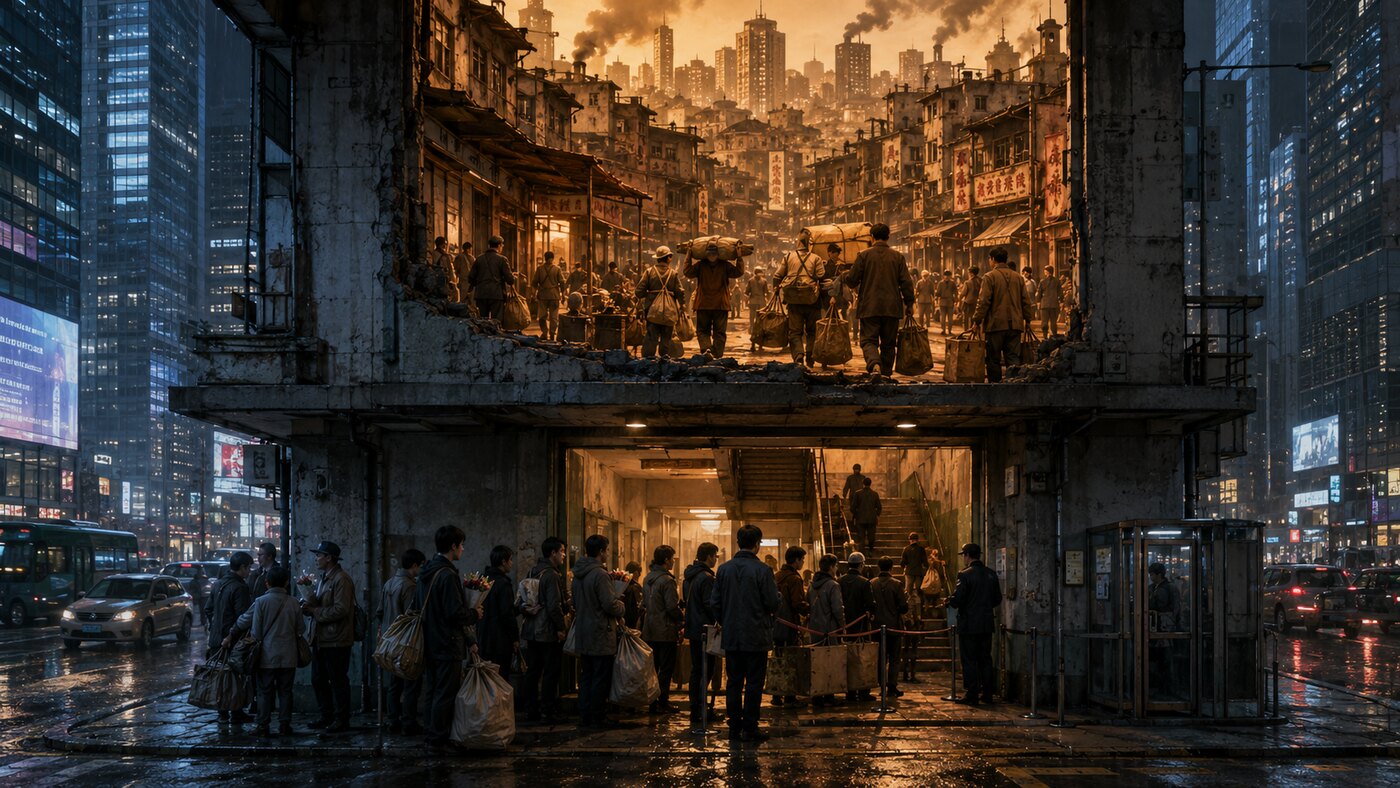
One city at two dates. Shimen today is grey glass, ring roads and a falling population; Shimen upstairs is the same street grid at the top of its lungs — eight storeys of bathroom tile and gold mirror glass, roller shutters, foot-massage parlours, wedding studios next to funeral parlours, and above all of it a low industrial sky the colour of dishwater, with cranes standing in it like punctuation. Every fifth address is a customs post between the two.
The Show Flat, Golden Roc Gardens. A model apartment upstairs,permanently lit and permanently furnished, staged for a future that this side already knows did not arrive: the plastic fruit, the bookshelf of empty spines, the balcony rendering of a park never built. Down here the same block is two-thirds empty behind a demolition notice. Licensed visitors pay by the hour to sit in it, and the agent still gives the full presentation, because he always did.
The look
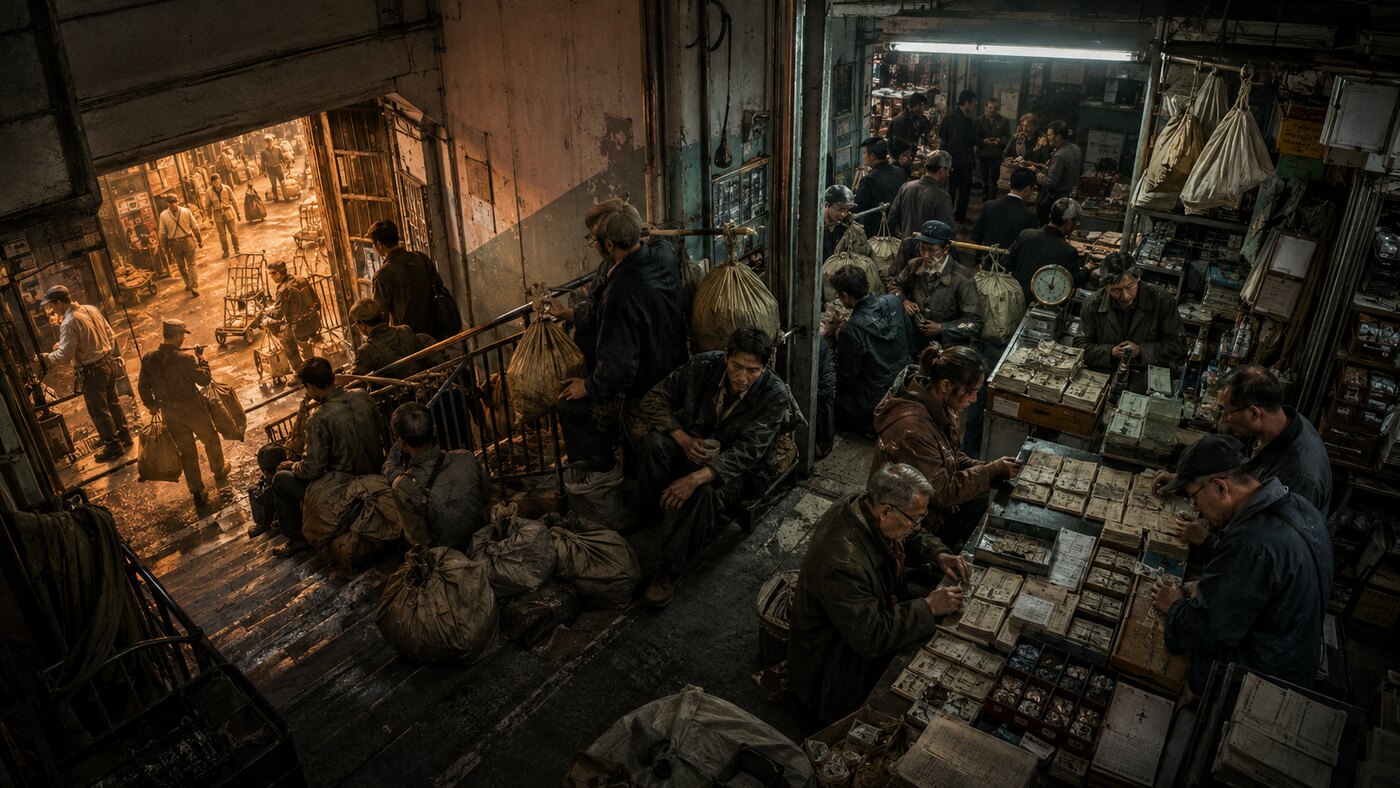
One photograph and its own twenty-year-old negative: down here LED grey-blue, glass and rain; up there a dishwater sky over bathroom-tile façades, gold mirror glass, red banner slogans, roller shutters and neon in every colour plastic can hold. Identical street grids wearing different decades. Stairwells packed with porters and bundles, and a customs desk under a fluorescent tube on the last landing before the light turns amber.
Peoples
Porters (背五樓的). The licensed carriers who climb five flights a thousand times a year, one crossing a day, both shoulders loaded. They prize endurance, exact scales, and the city's particular cheerfulness — a shrugging, wholehearted pessimism that treats every ending as scheduled and therefore no cause for panic. A porter never speaks inside the corridor. The old reason is that the passage remembers voices; the working reason is that anything said up there was always said, and customs pays informers by the sentence.
The Uphill Missing (上樓人). People of the Building Years who walked forward and did not go back — living now among their own futures, legally dead in a record that always showed them missing. Almost all of them came for the same reason, and almost all of them regret it: they arrived expecting the city the hoardings had promised. They prize reinvention, silence about the year they left, fierce loyalty to each other. An Uphill Missing never looks up their own family. It is not forbidden; it is simply understood, the way it is understood that you do not open someone else's post — and the ones who break it are the ones the others stop speaking to.
Door landlords (門東). Owners of qualifying buildings, most of them small men who bought badly in the boom and were made rich twenty years later by an accident of arithmetic. They hold leases only: no door building may be sold, altered or quietly inherited. They prize rent, succession, and the appearance of civic feeling. Every door landlord repoints their façade in public ceremony each spring — new grout, new tiles, the old slogan carefully preserved — because a building that fails inspection at either date loses the corridor at both, and with it the whole street's income.
Law
Shimen answers upward to a distant capital, but real power sits with the Crossing Commission, which licenses doors, sets duties, and — uniquely among government bodies — negotiates with its own predecessors by hand-carried letter, twenty years back.
- The Licensing Act — In the first unlicensed decade, four brothers bought a tower's worth of cement and rebar at Building Years prices and sold it here in a fortnight, and the price of concrete broke in both decades at once. Every door now has a customs desk, a quota, and a soldier on the fourth-floor landing.
- The Reflux Statute — The trade runs on things that were fake when they were bought and are precious now — counterfeit currency, counterfeit brands, counterfeit everything — and reflux is unanswerable in principle: a forged note spent upstairs has always been in circulation, and no audit here can recall money already spent twenty years ago. The Statute gave up on prevention and settled for registration, so that a court can at least say what a given object was on each of its two dates.
- The Demolition Moratorium — A developer levelled Door Building No. 40 to spite a rival's route and killed a corridor at both ends forever, stranding sixty families' livelihoods and one man on the wrong side of his own century. No number-five building may now be altered above the fourth floor without a national permit — which is why the boom's ugliest towers are the best-protected structures in Shimen.
- The Non-Interference Code — Nothing done upstairs can change today, but people kept trying, and the trying was cruel. Warning the Building Years of a collapse it cannot avoid, or courting a woman who is now your neighbour's grandmother, is prosecuted here as harassment. The law cannot protect the past from being changed. It can only protect it from being tormented.
- The Own-Life Rule — A commissioner met his younger self, told him everything, and watched him do precisely what he had always done. Approaching your own household upstairs is barred — not because it would alter anything, but because the Commission decided that a city where everyone is watched by their own future is not a city anyone could live in.
Economy
Currency: Today's yuan down here; twenty-year-old notes upstairs, priced by crease and serial year at the licensed dealers in the Fifth Floor Market. The spread between the two is the city's real interest rate.
Two arbitrages and a third that nobody taxes. The first is inflation: whatever was cheaper in the Building Years can be bought there and carried here. The second is authenticity: a knock-off bought upstairs for nothing is, down here, a period artefact of a brand that never legally existed, and collectors pay accordingly. The third is time itself — an hour in a street that has been demolished — and the Commission has never worked out how to put a duty on it.
| One stairweight of goods bought at old prices, carried down | duty 22% of the price gap | Assessed on the gap, not the goods, which is why every customs desk keeps a twenty-year-old catalogue under the counter. |
| Ten thousand yuan in clean Building Years notes | 31,000 yuan today | Uncreased notes cost over three times face value; the soft, folded ones from the right serial years are what porters actually spend. |
| One hour in a licensed show flat | 80 yuan | Booked out months ahead by people who grew up in that estate. The agent's presentation is included, and cannot be shortened. |
| A sealed personal letter, either direction | free by law | Porters charge a shoulder courtesy of 5 yuan anyway and everyone pays it. Nothing in the letters can change anything. People write them regardless. |
A day in the life
Morning. Door buildings queue from six: porters with empty satchels, licensed commuters holding work permits for a decade that has ended, and the day's visitors carrying flowers to a street where the shop is still open. Upstairs it is already loud — tile saws, a radio, somebody's shutter going up.
Food. Shimen eats its own past. Vegetables at prices this market forgot, and a whole cuisine that survives only because a restaurant which closed eighteen years ago is, upstairs, still taking orders at noon under a signboard nobody has repainted.
Work. Half the city's economy is the corridor: portering, customs, note-dealing, forwarding, show-flat licensing, and the lawyers who specialise in property that exists at two dates and belongs to different people at each.
Night. Karaoke upstairs until four, and down here the ring road. At 23:40 the last-crossing bell rings through every stairwell in the city, and for twenty minutes Shimen sorts itself between decades before midnight closes the count.
Live tensions
- The corridor map is drifting, and the drift is accelerating. The Building Years' towers are only now turning twenty, opening doors in districts that never had them — and they are the same towers this decade has scheduled for redevelopment. The city is opening and closing doors on the same buildings, and the Commission is quietly buying the ugliest blocks in Shimen to keep them standing.
- Reflux cannot be fixed, only recorded. A counterfeit spent upstairs was always in circulation; a counterfeit carried down is a genuine artefact of something that never existed. The courts have stopped asking what things are and started asking only what date you are asking about.
- The Uphill Missing are becoming a political question rather than a curiosity. They cannot be deported — there is nowhere to send them but a date — and the register that lists them as long dead is the same register that decides who may vote.
Story seeds
- A porter recognises a face in the Fifth Floor Market: himself, twenty years younger, buying a brick of old notes. He has no memory of ever doing it — which means it has not happened to him yet.
- The demolition schedule lists a tower whose corridor is the only route the Uphill Missing use to visit their own mothers. The owner can be persuaded. The Commission cannot.
- A woman crosses every day for a year to sit in a café opposite her father, who died eleven years ago and who has begun, upstairs, to nod at her as a regular.
- A show flat's agent has started addressing his presentation to one particular visitor — by name, and by a name she has not used since she was nine.
Glossary
- Upstairs — Twenty years ago; also the direction. Nobody in Shimen says the past — they say up.
- The Building Years (大興年) — The boom that is permanently in progress upstairs, and permanently over down here. Everyone knows its ending; nobody up there does.
- Stairweight (階重) — One porter, five flights, one crossing — the trade's unit of account and its unit of exhaustion.
- Reflux — Anything carried down from upstairs, and the legal category it lands in: fake at purchase, genuine at sale, taxed on the difference.
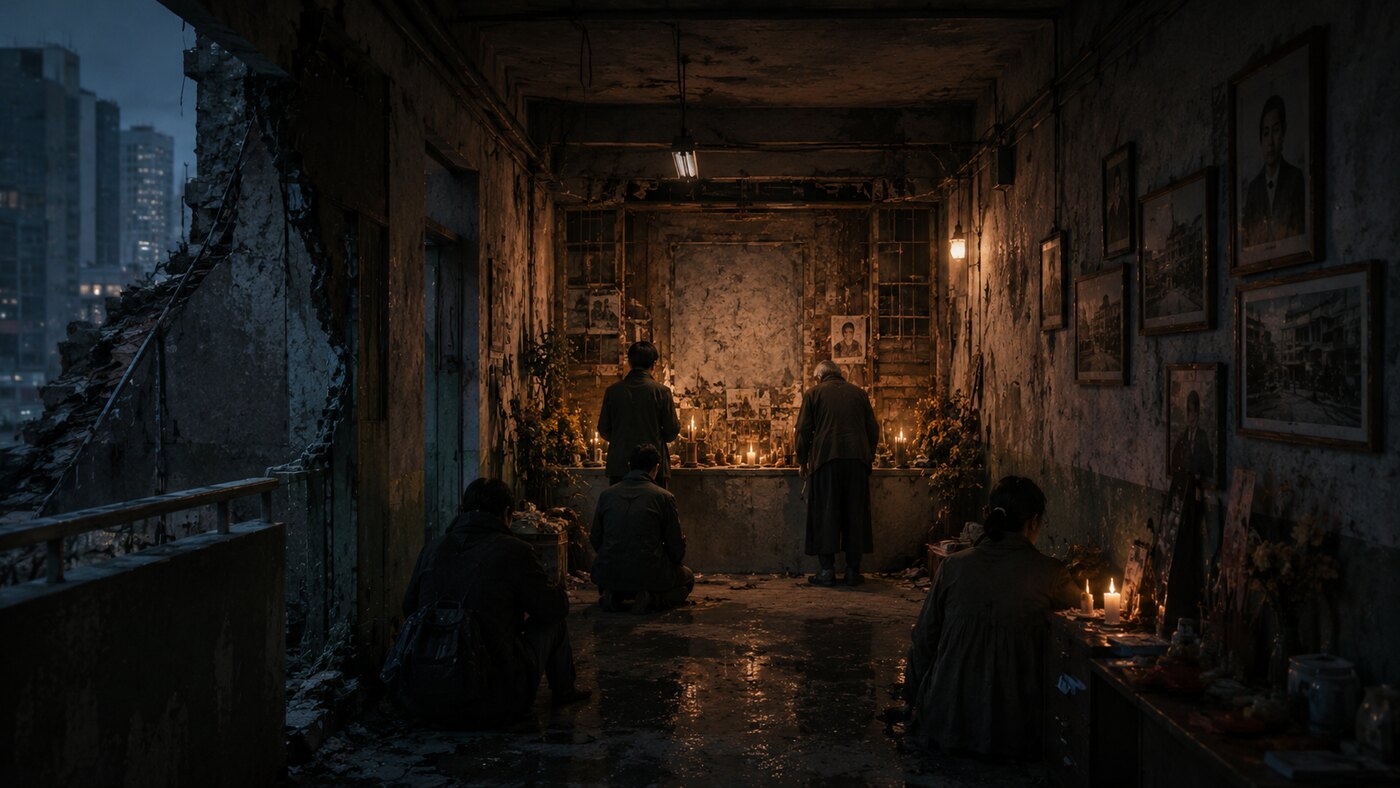
- Dead door — A corridor killed by demolition at either date — plastered, shrined, and mourned at both ends.
- It was always going to be — Shimen's shrug, said about anything done upstairs. Half an acknowledgement that the deed is already in the record, half an excuse for having done it, and the closest thing the city has to a philosophy.
Ask the Lorekeeper
Ask this world anything — how a trial works, what dinner costs, what happens if you break the hinge's rules. The answer stays strictly in canon, or extends it by cause and effect.
There are ninety-eight more worlds to question. Back to the Atlas.